Most couples are surprised to learn that the images they fall in love with are not simply the result of pressing a shutter button. The real magic happens afterwards, in the editing suite, where raw files are transformed into the emotional, cohesive story you will cherish for a lifetime. Editing transforms raw wedding photos into a cohesive, emotional narrative by correcting technical issues like exposure and white balance, enhancing mood, and ensuring consistency across the gallery. This guide will walk you through exactly what editing involves, why it matters so deeply, and how to make sure your photographer’s approach matches your vision.
Table of Contents
- Why editing matters in wedding photography
- The editing workflow: from thousands of shots to a perfected gallery
- Editing vs retouching: what couples need to know
- How editing solves wedding day challenges
- Preserving authenticity: editing for real moments
- What to ask photographers about editing
- The lasting impact of expert editing
- Enhance your story with professional editing
- Frequently asked questions
Key Takeaways
| Point | Details |
|---|---|
| Editing shapes your story | Editing transforms your wedding photos into a cohesive, emotional narrative. |
| Consistent albums feel seamless | Professional editing ensures every photo fits the overall look and mood of your day. |
| Retouching is selective | Only highlight images get special retouching; most are expertly edited for authenticity. |
| Editing fixes common issues | Problems like poor lighting or unexpected distractions are often solved in post-production. |
| Ask about editing style | Check before-and-after examples to confirm your photographer’s editing matches your vision. |
Why editing matters in wedding photography
Editing is far more than a technical afterthought. It is the process that defines the look, feel, and emotional weight of your entire wedding collection. Without it, even the most beautifully composed shot can feel flat, inconsistent, or disconnected from the rest of your gallery.
“A wedding gallery without consistent editing is like a book with chapters written in completely different styles. It loses its power to move you.”
The lasting impact of professional editing is felt every time you open your album, years after the day itself. Editing shapes the editorial style in wedding photography, giving your images a signature look that feels intentional and personal. It also supports the photojournalism value for couples by ensuring candid, real moments are presented at their very best.
Here is what skilled editing actually achieves for your wedding gallery:
- Corrects exposure and white balance so every image looks natural and true to life
- Enhances mood and atmosphere to reflect the emotion of each moment
- Ensures consistency across your gallery so the collection feels like one seamless story
- Removes minor distractions that would otherwise pull focus from you and your partner
- Brings out colour and detail in ways the camera alone cannot always capture
Editing is not about making things look fake or over-processed. It is an artful, considered process that elevates genuine moments into lasting memories.
Now that you realise the importance of editing, let’s uncover what actually happens during this process.
The editing workflow: from thousands of shots to a perfected gallery
After your wedding day, your photographer will typically have thousands of images to work through. The journey from those raw files to your finished wedding gallery involves several careful stages.
The core editing workflow follows a structured sequence: culling selects 500 to 800 images from 3,000 to 5,000 or more shots, followed by basic panel adjustments for exposure and contrast, HSL colour work for skin tones, tone curve styling, local masking, sharpening and noise reduction, and finally export.
Here is how the process typically unfolds:
- Culling — Reviewing every shot and selecting only the strongest images that tell your story
- Basic adjustments — Correcting exposure, contrast, and white balance across all selected images
- Colour grading — Applying a consistent colour palette and creative style to the whole gallery
- Skin tone refinement — Ensuring natural, flattering skin tones under varied lighting conditions
- Local adjustments — Fine-tuning specific areas of individual images for maximum impact
- Sharpening and noise reduction — Polishing every image so it looks crisp and clean
- Export — Delivering a cohesive, shareable gallery in the agreed format
| Stage | Purpose | Applies to |
|---|---|---|
| Culling | Select the best moments | All raw files |
| Basic adjustments | Fix exposure and colour | All selected images |
| Colour grading | Apply creative style | All selected images |
| Retouching | Advanced fixes | Key hero shots only |
| Export | Deliver final gallery | All edited images |
Pro Tip: Ask your photographer how many images you can expect in your final gallery. A typical full-day wedding produces between 500 and 800 edited images, which is a healthy number for telling your complete story without overwhelming you.
AI tools save up to 96% of time on repetitive tasks like culling and basic edits, but the creative decisions, the choices that give your gallery its heart, are always human-led.
With the workflow made clear, it’s time to explore how editing varies depending on the shot and why your album includes both edited and retouched images.
Editing vs retouching: what couples need to know
Many couples use the words editing and retouching interchangeably, but they are quite different things. Understanding the distinction helps you set realistic expectations and ask the right questions.
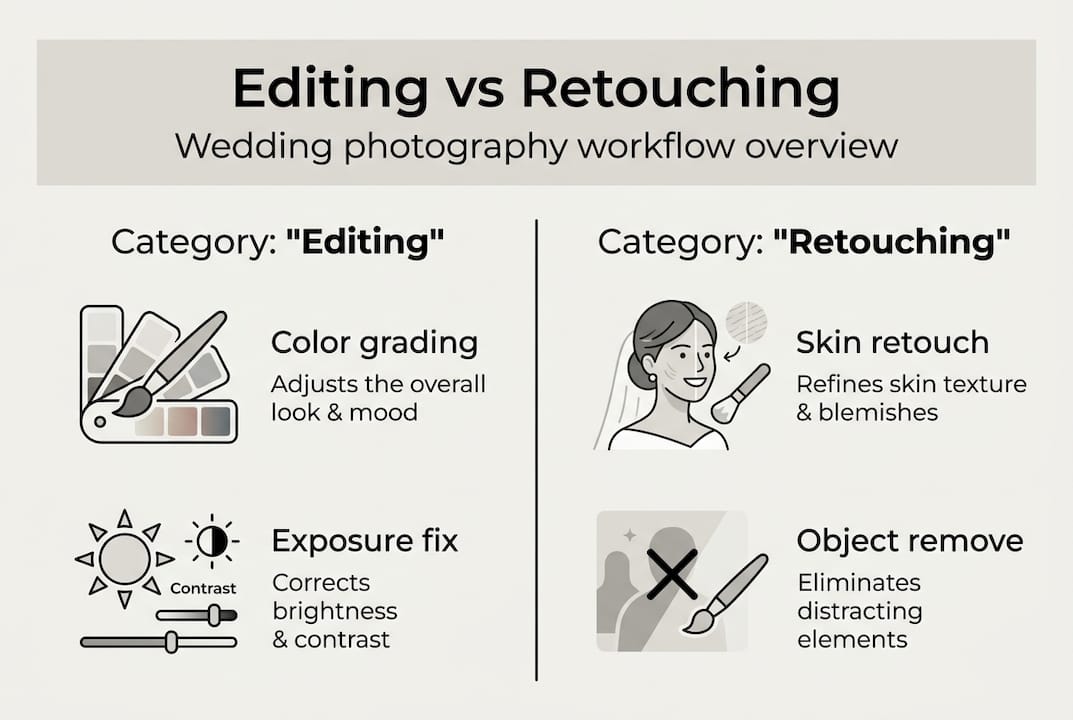
Editing covers all images through colour grading and exposure adjustment, while retouching is reserved for hero shots and involves advanced work like skin smoothing and object removal. Avoiding over-smoothing is important to preserve a natural look.
“The goal is always to enhance what is already there, not to create something artificial. Your wedding photos should look like you, just at your very best.”
Here is a simple comparison to clarify the difference:
| Editing | Retouching | |
|---|---|---|
| Applied to | All gallery images | Selected hero shots |
| Includes | Colour, exposure, style | Skin, objects, complex fixes |
| Goal | Consistency and mood | Perfecting key moments |
| Time required | Moderate | Significant |
Exploring the candid workflow explained shows how a documentary approach to shooting actually reduces the need for heavy retouching, because genuine moments captured well need far less correction. Similarly, creative photo approaches that are thoughtfully planned in advance result in images that shine with minimal post-production work.
Armed with this knowledge, let’s analyse how editing tackles tricky situations unique to real weddings.
How editing solves wedding day challenges
No wedding day is perfectly controlled. Lighting shifts, guests wander into frame, and weather rarely follows the plan. This is where skilled editing becomes genuinely invaluable.
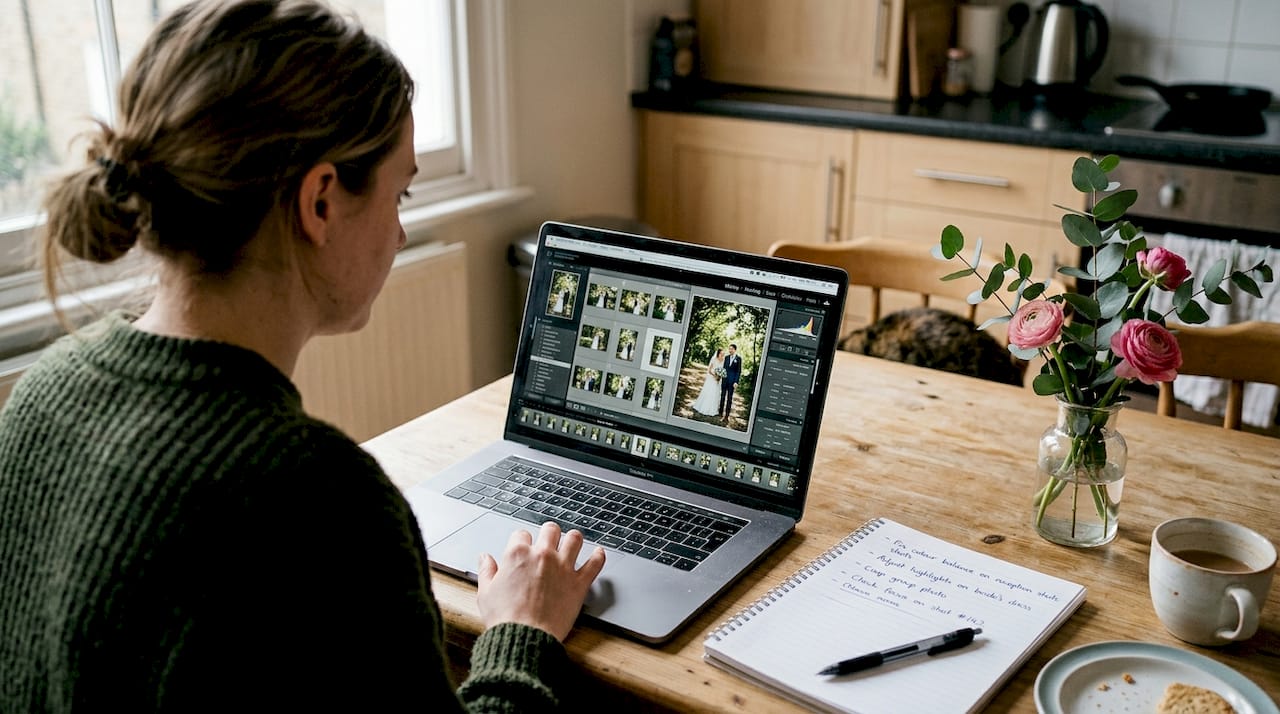
Common wedding editing challenges include mixed lighting between ceremony and reception, skin tones under varied lights, background distractions like guests or signage, and closed eyes in group shots, all of which are addressed through selective adjustments, AI tools, and compositing.
Here are the most frequent challenges and how editing resolves them:
- Mixed indoor and outdoor lighting — Selective colour and exposure adjustments balance the warmth of candlelight with the cool tones of daylight
- Unflattering background distractions — Unwanted guests, signs, or objects can often be removed or minimised
- Closed eyes in group shots — Compositing techniques can combine the best elements from multiple frames
- Shifting weather — Dramatic skies can be enhanced, and flat grey light can be warmed to feel more inviting
- Harsh shadows — Local adjustments bring back detail and softness in difficult lighting conditions
Pro Tip: Share your venue details and any known lighting challenges with your photographer before the day. Knowing what to expect allows them to capture natural moments more effectively and plan their editing approach in advance.
Following best wedding photography practices means anticipating these challenges rather than simply reacting to them, which always produces stronger results.
Since editing is both technical and artistic, how does it maintain authenticity and keep the wedding narrative true?
Preserving authenticity: editing for real moments
One of the most common concerns couples share with us is that editing might make their photos look over-processed or unlike themselves. The truth is that thoughtful editing does the opposite. It preserves and enhances the genuine emotion of your day.
The principle of shooting for the edit means nailing exposure and white balance in-camera to minimise the need for heavy post-production fixes, resulting in more natural and authentic outcomes. Presets and batch editing maintain consistency across the gallery, while individual tweaks ensure each image retains its unique emotional truth.
Here is how authenticity is protected throughout the editing process:
- Presets are applied thoughtfully, not blindly, so each image still reflects its unique moment
- Skin tones are kept natural rather than smoothed into something unrecognisable
- Emotions are the priority, meaning an imperfect but genuine laugh will always be chosen over a technically perfect but stiff pose
- Storytelling in photography guides every editing decision, keeping the narrative honest and moving
Pro Tip: When reviewing a photographer’s portfolio, look for consistency across an entire wedding gallery rather than just a handful of standout shots. This tells you far more about their editing approach and whether it will suit your taste. You can also explore essential wedding photo moments to understand which images deserve the most careful attention.
With a clear understanding of what editing achieves, you can now make informed choices and ask meaningful questions before booking a wedding photographer.
What to ask photographers about editing
Knowing the right questions to ask puts you in a much stronger position when choosing your photographer. Editing style is just as important as shooting style, and the two should always align.
The editing workflow typically includes culling, colour grading, exposure adjustment, tone consistency, and sometimes retouching for select images, so understanding what is included in your package is essential.
Here are the key questions to ask at your consultation:
- What does your editing process include? Ask specifically about colour grading, retouching, and any extras
- How many images will I receive? Clarify the expected number of edited images in your final gallery
- What is your turnaround time? Most photographers deliver within four to eight weeks
- Can I see before-and-after examples? This reveals the true extent of their editing work
- How many images receive advanced retouching? Understand which shots get the extra attention
- Does your editing style match my taste? Review full galleries, not just highlight images
Exploring wedding photography packages in detail will also help you understand exactly what is included in terms of editing, delivery, and album options.
To wrap up, let’s see how a professional approach to editing shapes the emotions and memories you’ll cherish for life.
The lasting impact of expert editing
Well-executed editing is invisible. You do not notice it consciously, but you feel it every time you look at your photos. It is the reason certain images make you catch your breath, or bring tears to your eyes years after the day.
Editing ensures consistency across the gallery, enhances mood, and tells a complete wedding story that feels true to who you are and how the day actually felt.
Your wedding album is something you will return to again and again, sharing it with children, grandchildren, and friends who were not there. The quality of the editing determines whether those images still move you in twenty years’ time. Investing in a photographer who takes editing seriously is not a luxury. It is the difference between a gallery you glance at occasionally and one you genuinely treasure. Explore the full range of wedding gallery features to understand what a beautifully edited collection can look like.
Enhance your story with professional editing
At Plomien Wedding Photography, we believe that editing is where your story truly comes to life. Every image we deliver has been carefully considered, colour-graded, and refined to reflect the genuine emotion and beauty of your day. We pour the same passion into the editing suite as we do into every moment we capture on your wedding day.
If you are ready to invest in lasting wedding photography that will move you for decades to come, we would love to hear from you. Explore our wedding photo packages to find the right level of coverage for your celebration, or discover what full day wedding coverage truly includes. Your once-in-a-lifetime moments deserve nothing less than the very best care, from the first click of the shutter to the final image in your gallery.
Frequently asked questions
How long does it take to edit a wedding gallery?
Most professional photographers deliver edited galleries within four to eight weeks, depending on their workflow and the number of images selected. Busy seasons may extend this slightly, so always confirm the timeline before booking.
What is included in basic editing versus retouching?
Basic editing covers all images through colour grading and exposure adjustment, while retouching is reserved for key shots and involves advanced work like skin smoothing or object removal. The aim is always a natural, authentic result rather than an over-processed finish.
Can editing fix poor lighting or background distractions?
Yes, selective adjustments and compositing can address mixed lighting, remove background distractions, and even fix closed eyes in group shots. Skilled editing ensures your genuine moments remain the focus of every image.
Do all wedding photos get retouched?
No, only selected highlight images receive advanced retouching. The majority of your gallery is edited for consistency, colour, and style, which is sufficient to make every image look polished and beautiful.