TL;DR:
- Wedding photographers perform extensive pre-ceremony planning, including venue scouting and timeline creation.
- During the ceremony, they operate discreetly, capturing emotional moments with minimal disruption.
- The final gallery emphasizes candid, authentic images that preserve the genuine atmosphere and details of the day.
Most couples assume their wedding photographer simply points a camera and presses a button. The reality is far more layered. Behind every tearful glance, every nervous smile, and every stolen moment between you and your partner, there is a professional making dozens of rapid decisions per minute. From pre-ceremony venue scouting to the final recessional shot, your photographer is working with quiet intensity to preserve the moments you will cherish for the rest of your life. This guide pulls back the curtain on what truly happens behind the lens during your Yorkshire ceremony, and why that expertise matters more than most couples realise.
Table of Contents
- Setting the stage: Preparation before the ceremony
- Invisible presence: The art of discreet ceremony coverage
- Solo photographers vs team coverage: What suits your Yorkshire ceremony?
- Dealing with restrictions and traditions: Navigating the Yorkshire wedding landscape
- From camera to gallery: What couples receive after the ceremony
- Perspective: Why invisible expertise is your ceremony’s best investment
- Capture every detail of your Yorkshire ceremony
- Frequently asked questions
Key Takeaways
| Point | Details |
|---|---|
| Preparation is essential | Photographers scout venues and coordinate with officiants to ensure seamless ceremony coverage. |
| Discretion captures emotion | A skilled photographer documents your ceremony’s emotional moments without disturbing the experience. |
| Solo vs team coverage | Choosing between one or multiple photographers depends on ceremony size and your vision for gallery variety. |
| Adaptability is key | Photographers navigate venue restrictions and traditions to respectfully document every memory. |
| Gallery highlights | Couples can expect ceremony images to form a major part of their treasured wedding gallery. |
Setting the stage: Preparation before the ceremony
Long before you walk down the aisle, your photographer is already working. The preparation phase is where great ceremony coverage is actually won or lost, and it involves far more than simply showing up with a camera bag.
One of the first steps is a pre-ceremony consultation with your venue and officiant. As photographers liaise with officiants and scout venues in advance to plan for lighting, rules, and key moments, they arrive on your wedding day with a clear picture of what is possible. This means no surprises, no fumbling for position, and no missed shots.
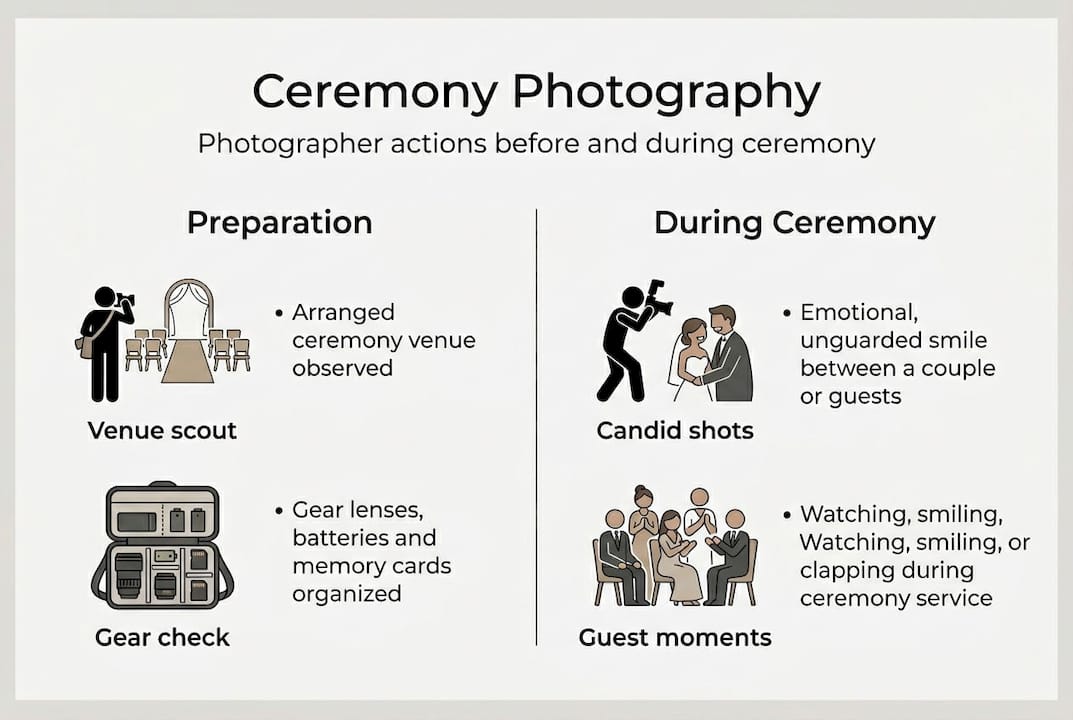
Venue scouting is particularly important in Yorkshire, where ceremony spaces range from grand country houses like Bowcliffe Hall to intimate village churches with narrow aisles and dim candlelight. Each space presents unique challenges. Your photographer will assess natural light sources, identify the best angles for the processional, and note any areas where movement is restricted.
For larger Yorkshire ceremonies, a second shooter or assistant is often brought in. This allows simultaneous coverage from multiple positions, ensuring that while one photographer captures your expression as you see your partner for the first time, the other records your partner’s reaction. That dual perspective is something a single photographer simply cannot achieve alone.
Telephoto lenses are another essential tool. They allow your photographer to master the ceremony guide from a respectful distance, capturing intimate close-ups without physically intruding on the space. You will barely notice the camera, yet the images will feel close and personal.
A detailed ceremony photo timeline is also created in collaboration with you. This is your opportunity to flag the moments that matter most, whether that is a reading by a grandparent or a surprise musical performance. Reviewing our wedding photo timeline guide can help you prepare for this conversation.
Here is what thorough pre-ceremony preparation typically covers:
- Venue walkthrough to assess light, space, and access
- Confirmation of any flash or movement restrictions
- Briefing with the officiant on ceremony order and key moments
- Positioning plan for solo or team coverage
- Agreed timeline aligned with your personal priorities
Pro Tip: Ask your photographer to visit your venue at the same time of day as your ceremony. Lighting changes dramatically throughout the day, and a morning scout will not reflect afternoon conditions.
Having established the skill required behind the scenes, next we go to what happens the moment the ceremony begins.
Invisible presence: The art of discreet ceremony coverage
Once the ceremony begins, your photographer shifts into what many in the industry call a state of heightened awareness. Every movement is deliberate. Every position is chosen for maximum coverage with minimum disruption.
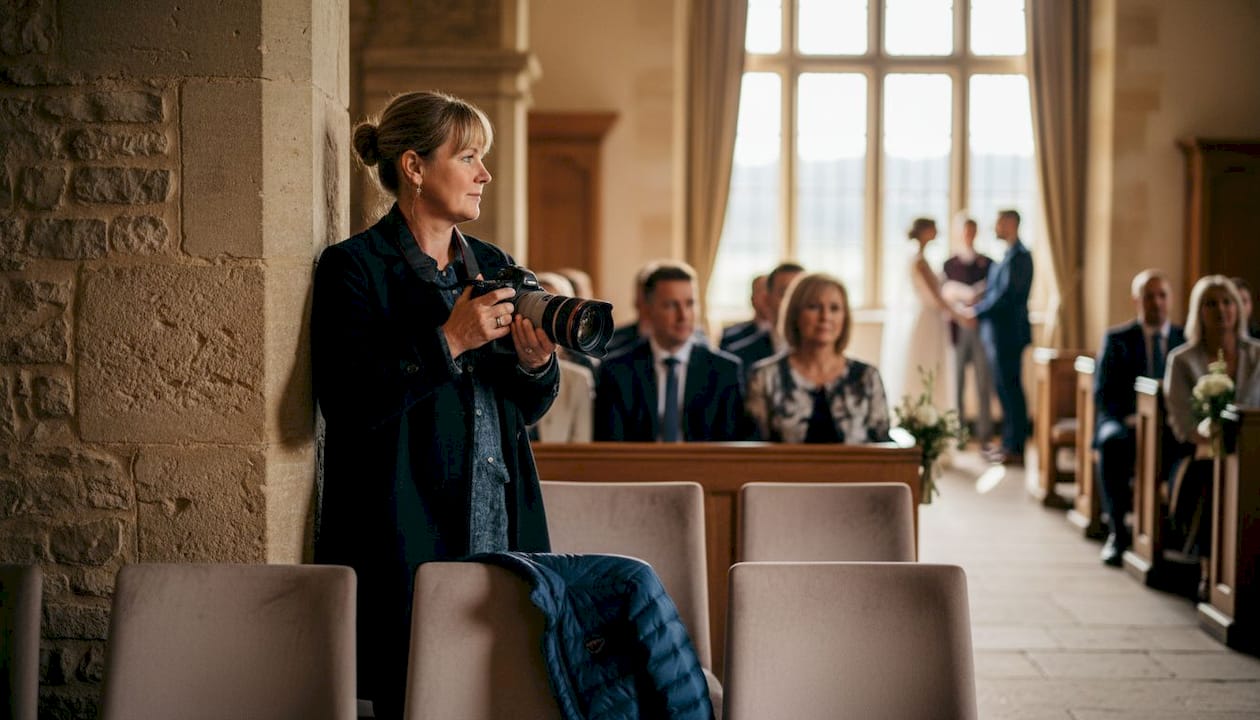
A skilled wedding photographer operates like a photographic ninja, documenting the processional, vows, rings, first kiss, and recessional with minimal intrusion. Shutter sounds are kept as quiet as possible. Movement is slow and purposeful, never crossing in front of guests or breaking sightlines.
The key moments your photographer is always watching for include:
- The processional and your first look at each other
- Your expressions during the vows
- The ring exchange, including close-up detail shots
- The first kiss and the immediate emotional reaction that follows
- The recessional, often full of pure, unguarded joy
But great ceremony photography goes well beyond the couple. Your photographer is simultaneously scanning the room for your parents wiping tears, a child peeking through the pews, or a friend laughing quietly at a private joke. These peripheral moments are what transform a ceremony gallery from a record of events into a genuine story.
Positioning is everything. Side-aisle placements allow for profile shots that capture both partners in a single frame. Back-of-room positioning gives context, showing the full scale of the space and the gathered guests. Neither position requires the photographer to move through the ceremony space, preserving the atmosphere entirely.
This approach is at the heart of wedding photojournalism, where the goal is to observe and document rather than direct and stage. The result is a collection of candid ceremony moments that feel real because they are.
“Ceremony coverage typically provides 15-25% of the final gallery, supplying the core emotional highlights of the day.”
That percentage represents the images you will return to most often. They are the ones you will frame, share, and show your children. The ceremony photography expertise required to produce them consistently is genuinely significant.
With an understanding of a photographer’s invisible artistry, let’s explore how teams or solo shooters adapt to fit every ceremony scale.
Solo photographers vs team coverage: What suits your Yorkshire ceremony?
Choosing between a solo photographer and a team is one of the most practical decisions you will make, and it has a real impact on your final gallery.
Solo photographers suit intimate or micro weddings, while teams enable multi-angle coverage for 100 or more guests but may add cost and complexity. Here is how the two options compare:
| Factor | Solo photographer | Photography team |
|---|---|---|
| Guest count | Up to 60 guests | 60 or more guests |
| Coverage angles | Single perspective | Multiple simultaneous angles |
| Cost | Lower | Higher |
| Coordination | Simpler | More complex |
| Ideal for | Intimate ceremonies | Large or lavish venues |
For many Yorkshire couples planning smaller ceremonies in converted barns or private gardens, a single skilled photographer is entirely sufficient. They can move fluidly through the space, building a rapport with guests and capturing the intimacy of a smaller gathering in a way a larger team sometimes cannot.
For weddings at grand venues, a second shooter becomes genuinely valuable. While the lead photographer focuses on you during the vows, the second shooter captures your guests’ reactions simultaneously. That combination of perspectives gives your gallery a cinematic quality that a solo shooter simply cannot replicate.
There are also practical benefits to having a team. If the lead photographer needs to reposition, the second shooter maintains continuous coverage. There is no gap in the story.
Here are the key questions to help you decide:
- How many guests are you expecting?
- How large or complex is your ceremony venue?
- Do you want wide contextual shots alongside intimate close-ups?
- What is your budget for photography?
Pro Tip: Even if your wedding is small, consider whether your venue has multiple rooms or a complex layout. A second shooter can cover the groom’s preparation and the bride’s arrival simultaneously, adding real value regardless of guest count. Explore our wedding photo essentials and creative photo ideas for further inspiration.
For essential photography tips on team dynamics, the guidance is clear: match your coverage to your ceremony’s scale.
Now that you have pictured how your ceremony might be covered, it is vital to know how photographers navigate variations, from restrictions to unique cultural traditions.
Dealing with restrictions and traditions: Navigating the Yorkshire wedding landscape
Every ceremony is different, and Yorkshire’s diverse wedding landscape means photographers must be genuinely adaptable. Venue restrictions, cultural rituals, and types of officiant shape what a photographer can do, and the best professionals prepare for every scenario in advance.
Here is how common ceremony types typically affect coverage:
| Ceremony type | Typical restrictions | Photographer’s approach |
|---|---|---|
| Church of England | No flash, limited movement | Telephoto lens, fixed positions |
| Civil ceremony | Usually flexible | Multiple angles, closer access |
| Celebrant-led | Varies by venue | Agreed in advance with celebrant |
| Multicultural | Specific ritual protocols | Pre-briefing on traditions |
| Elopement | Minimal restrictions | Intimate, close-range coverage |
When restrictions are in place, experienced photographers do not simply accept limitations. They plan around them. A no-flash rule, for example, prompts the use of fast lenses that perform beautifully in low light. A restriction on movement means pre-selecting fixed positions that still deliver a variety of compositions.
Here is the typical process for navigating restrictions and traditions:
- Initial consultation with the couple to understand ceremony type and any known rules
- Direct communication with the venue coordinator or registrar
- Briefing with the officiant on ceremony order and any sensitive moments
- Equipment selection tailored to the specific environment
- Positioning plan agreed before the day
For multicultural or faith-based ceremonies, preparation goes deeper. Your photographer should research relevant traditions, understand which moments carry the greatest significance, and approach the day with genuine respect. Our candid photography process reflects this commitment, and you can see how it plays out in real Yorkshire wedding moments.
Pro Tip: Share a brief written overview of your ceremony’s key traditions with your photographer at least two weeks before the wedding. Even a short paragraph can help them anticipate and prepare for moments that might otherwise be missed.
For further guidance, the ceremony photography essentials resource covers how experienced photographers handle diverse ceremony environments with care.
Armed with practical knowledge of coverage and restrictions, let’s turn to what you can expect in your final gallery and how the best moments are selected.
From camera to gallery: What couples receive after the ceremony
The ceremony is over. You are married. But your photographer’s work is far from finished. The images captured during those precious minutes now need to be curated, edited, and delivered in a way that tells your story with honesty and beauty.
Ceremony images comprise 15-25% of a typical full-day gallery, with experienced photographers delivering upwards of 600 images for a full Yorkshire wedding. That is a substantial body of work, and the selection process is as skilled as the photography itself.
Your ceremony gallery will typically include:
- Arrival and anticipation shots capturing the atmosphere before proceedings begin
- Processional images showing the full emotional weight of the walk down the aisle
- Vow and ring exchange close-ups preserving the quiet intimacy of those words
- Reaction shots from guests, family members, and your partner
- Candid details such as flowers, order of service cards, and architectural features of the venue
- Recessional images full of movement, colour, and joy
What makes these images genuinely valuable is not just their technical quality. It is the fact that they were taken without you noticing. When you look back at your ceremony photographs, you will not see posed smiles or stiff compositions. You will see yourself, exactly as you were, on one of the most significant days of your life.
Yorkshire couples consistently report being barely aware of their photographer during the ceremony, yet receiving galleries that feel comprehensive and deeply moving. That is the hallmark of invisible expertise. Understanding why investing in wedding photography matters comes into sharp focus when you see the wedding photography benchmarks that experienced professionals consistently meet.
We have outlined the process, the adaptability required, and the results you will treasure. Now, here is an unfiltered, expert perspective for couples making this choice.
Perspective: Why invisible expertise is your ceremony’s best investment
There is a persistent idea that with smartphones in every pocket, professional ceremony photography is somehow less essential than it once was. We disagree, and here is why.
A guest with a phone is emotionally invested in the moment. They are laughing, crying, and experiencing the ceremony alongside everyone else. A professional photographer is doing something fundamentally different. They are anticipating the moment before it happens, positioning for it, and capturing it with technical precision while remaining emotionally present enough to recognise what matters.
The moments that mean the most are rarely the obvious ones. It is the flicker of nerves on your partner’s face just before you appear. It is your father’s expression when he sees you in your dress for the first time. These are not moments you can recreate or stage. They exist for a fraction of a second, and only someone trained in the importance of photojournalism will be watching for them.
Your ceremony photographer is not just a picture-taker. They are a guardian of memory, present yet unseen, working quietly so that you can be fully in the moment. Choosing the right one means you will relive the warmth and reality of your Yorkshire ceremony for decades to come.
Capture every detail of your Yorkshire ceremony
Your ceremony is unrepeatable. Every laugh, every tear, every whispered word between you and your partner happens once. Professional ceremony coverage ensures none of it disappears.

At Plomien Wedding Photography, we specialise in discreet, authentic coverage that lets you stay fully present on your wedding day while we take care of preserving every meaningful moment. Whether you are planning an intimate elopement or a grand celebration at one of Yorkshire’s finest venues, we would love to help. Explore our full wedding day coverage options and discover the lasting impact of professional photography for yourself. Get in touch to start the conversation.
Frequently asked questions
How many ceremony photos will we receive from our wedding photographer?
Ceremony photos typically make up 15-25% of your total gallery, with experienced photographers delivering over 600 images for a full day. The exact number depends on your ceremony length and the level of coverage agreed.
Can photographers use flash or move freely during the ceremony?
Venue restrictions commonly limit flash and movement during the ceremony, particularly in religious settings. Your photographer should confirm the rules with your officiant well in advance and adjust their equipment and positioning accordingly.
What is better: one photographer or a team for our wedding ceremony?
Solo suits small events and intimate ceremonies, while a team is recommended for weddings with 100 or more guests where multiple angles and simultaneous coverage are needed. Your venue size and desired gallery variety are the deciding factors.
How do photographers prepare for different ceremony types or cultural traditions?
They liaise with your officiant, research relevant traditions, and adapt their techniques to respectfully capture every meaningful moment. A pre-wedding briefing with specific details about your ceremony is always the best starting point.
Recommended
- Why Invest in Wedding Photography: Lasting Impact – Plomien Wedding Photography
- 7 Essential Best Wedding Photography Practices for Couples – Plomien Wedding Photography
- Master the Candid Wedding Photography Process for Stunning Memories – Plomien Wedding Photography
- Why Wedding Photojournalism Matters for Couples – Plomien Wedding Photography